How to Read an Indonesian Cocoa Bean Certificate of Analysis
Learn how to read a cocoa bean certificate of analysis for Indonesian lots, from moisture and cut test results to order checks.
By Aditya WijayaHead of Export SalesSix years structuring Indonesian cocoa programmes for chocolate makers and grinders across Europe and Southeast Asia.
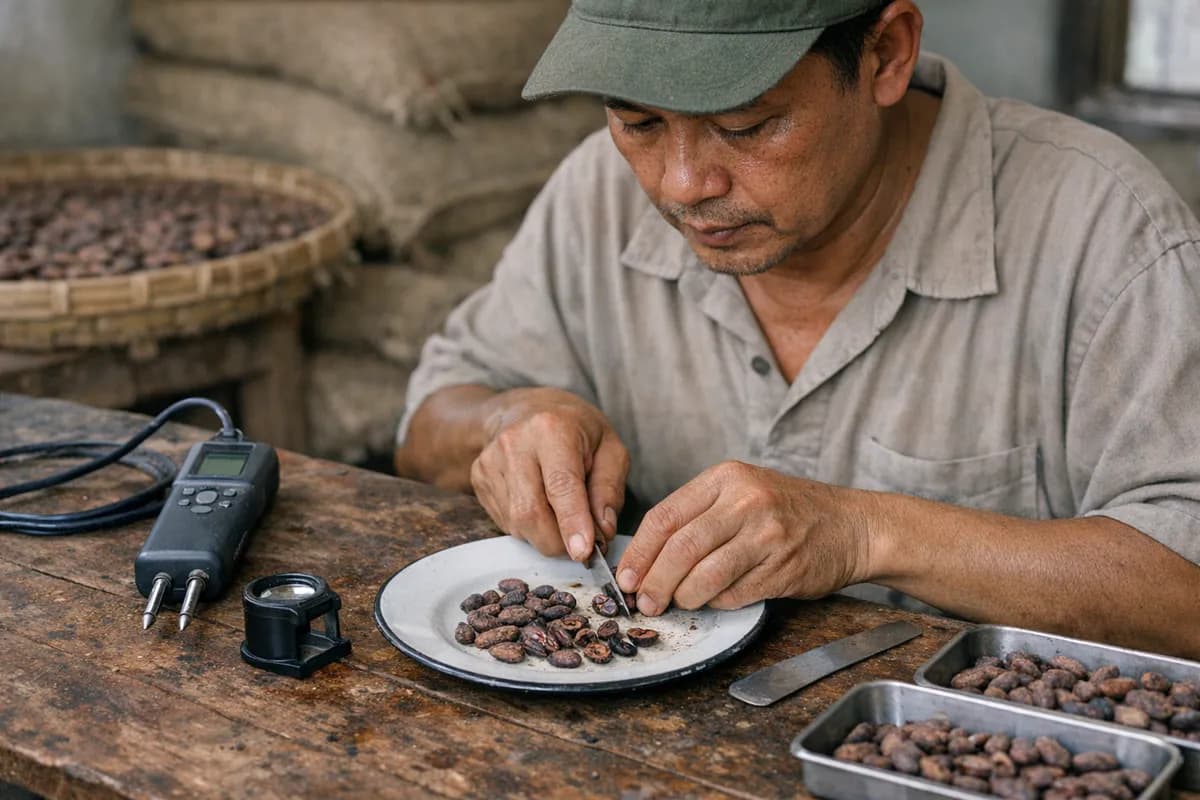
A cocoa bean certificate of analysis is useful only when the buyer can connect each result to the lot being offered, the specification in the purchase order, and the shipment documents that will follow. We read it as a control document, not as a sales brochure.
For Indonesian cocoa beans, the main checks are usually moisture, bean count, cut test results, fat content, and visible defects such as mouldy, slaty, or insect-damaged beans. The COA should also make sense beside the product name, origin, grade, packing basis, and HS code used in the commercial file.
What should an Indonesian cocoa bean certificate of analysis confirm?
A cocoa bean certificate of analysis should confirm the measured quality of a defined lot against the agreed specification. It should not be treated as a stand-alone document if the lot number, product name, origin, or shipment quantity cannot be matched to the purchase file.
We look first at identification. The COA should state what was tested: cocoa beans, the origin if agreed, the process type such as fermented or unfermented, the grade, and the lot reference. If the purchase order says Sulawesi fermented Grade A but the COA only says “cocoa beans,” the document is too vague for a receiving team.
The next check is timing. A COA should be issued after the relevant lot has been prepared and tested, not copied from a previous shipment. Buyers should ask whether the COA is based on a pre-shipment sample, a composite sample, or a lot sample drawn from packed goods. The wording matters because a sample taken before final cleaning or drying may not represent the shipment your warehouse receives.
Then check that the COA uses the same commercial language as the quote. The product name, net weight, packing style, and HS code should fit the proforma invoice and packing list. For whole cocoa beans in our range, the HS code is 1801.00. If a document uses a different code, your broker should review it before shipment.
If you are still defining the product, start from our Indonesian cocoa beans range and decide whether your application needs fermented beans for flavour development or unfermented beans for industrial processing.
How should moisture, bean count, and cut test results be read?
Moisture, bean count, and cut test results show whether the beans fit the physical and process profile you ordered. Read each result against the contract specification, not against a generic idea of cocoa quality.
Moisture is one of the first values buyers check because it affects storage risk, handling, and claims discussion at arrival. Our cocoa bean specifications hold moisture at ≤ 7.5% across the listed bean products. A COA result should show the measured moisture for the lot, not only repeat the maximum limit. If the result is close to the limit, ask how the lot will be protected during storage, loading, and transit.
Bean count tells you the number of beans per 100 g. A lower count means larger average beans. In our range, Sulawesi Fermented Cocoa Beans, Grade A target bean count of ≤ 100 / 100 g, which is SNI size class A. Sumatra fermented Grade A targets ≤ 105 / 100 g, while unfermented Grade B products have their own size classes by origin. If your roaster or grinder is set up for a particular bean size, do not approve a COA without checking this line.
Featured product
Couverture Grade A, Sulawesi Fermented
Bean-to-bar and couverture fermented Sulawesi beans, cut-tested to ≥85% fermentation (house Grade A, SNI size class A).
Rainforest Alliance · ISO 22000 · Halal (BPJPH)
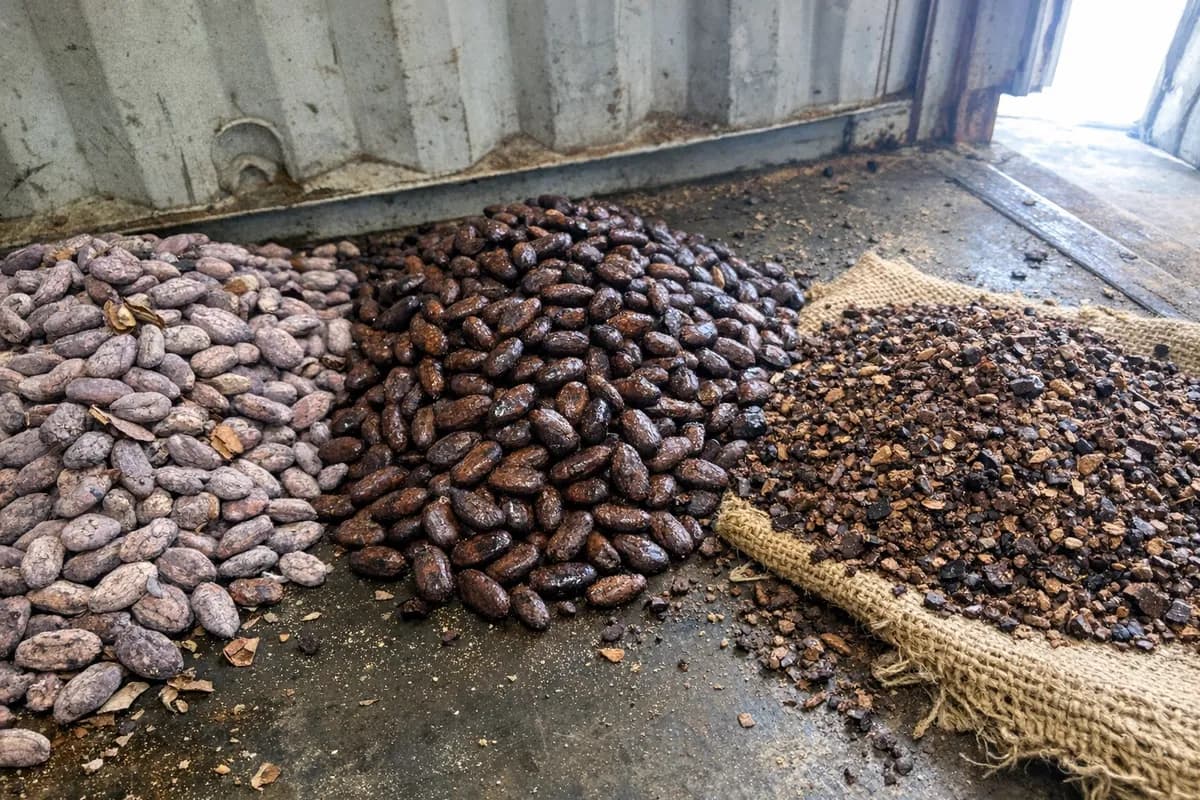
View specificationsCut test results need more context. For fermented Grade A beans, fermentation level is a defined buying point. Our Sulawesi and Papua fermented Grade A products target fermentation level of ≥ 85%, while Sumatra fermented Grade A targets ≥ 80%. For unfermented Grade B beans, the product specification does not use a fermentation percentage target. A buyer should not reject an unfermented lot because it does not look like a fermented Grade A lot.
For more background on size class versus commercial grade, see our guide to Indonesian SNI cocoa bean grading. It helps separate bean count from grade language before your procurement team writes the purchase order.
Which defect lines matter most on a cocoa bean COA?
The defect lines that usually change a buying decision are mouldy beans, slaty beans, and insect-damaged beans. These lines should be stated as measured results and compared with the agreed grade limit.
Mouldy beans are a direct quality concern, so buyers should treat this line carefully. Our fermented Grade A cocoa bean products hold mouldy beans at ≤ 3%, while our unfermented Grade B cocoa bean products hold mouldy beans at ≤ 5%. If the COA reports a result near the limit, ask for the sampling basis and confirm that packed bags will not be mixed with other lots after testing.
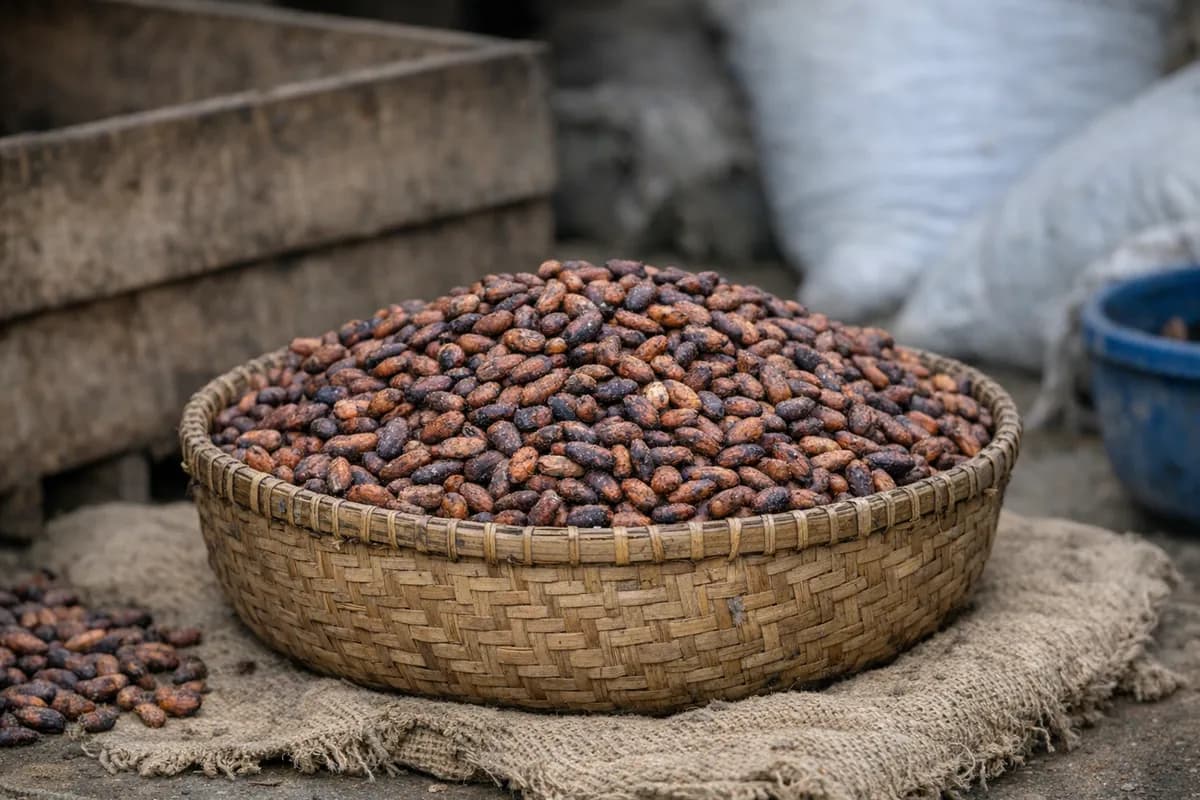
Slaty beans tell a different story. In fermented cocoa, a high slaty reading can indicate poor fermentation or uneven processing. Our fermented Grade A bean products hold slaty beans at ≤ 3%. Our unfermented Grade B bean products hold slaty beans at ≤ 5%, but the interpretation is different because the product is sold as unfermented. This is why the COA must match the product type.
Insect-damaged beans affect appearance, yield, and buyer acceptance. Our fermented Grade A bean products hold insect-damaged beans at ≤ 1%, while unfermented Grade B bean products hold them at ≤ 2%. If you have a stricter internal receiving limit, state it before quotation. A supplier cannot manage a private plant limit if it appears only after shipment.
Fat content is also worth reading, especially if your plant is pressing, grinding, or formulating. Our fermented Grade A beans list fat content at ≥ 52%, while our unfermented Grade B beans list fat content at ≥ 50%. A COA should show the lot result so your technical team can decide whether it fits the intended process.
What is the MOQ and price context for cocoa beans with a COA?
Our fermented Grade A cocoa beans have a minimum order of 13 MT, equal to 1 × 20 ft FCL. Our unfermented Grade B cocoa beans have a 5 MT minimum order and can be packed in 60 kg jute bags or bulk, depending on the product.
We do not give a market price figure in a guide because a useful cocoa bean quotation depends on the exact product and shipment. The main price drivers are grade, origin, process type, packing, volume, Incoterm, certification requirement, season, and freight basis if CFR or CIF is requested. A COA supports the quality side of that quotation, but it does not replace the commercial offer.
Packing should be decided before pricing. Fermented Grade A beans in our range are packed in 60 kg jute bags. Unfermented Grade B beans may be ordered in 60 kg jute bags or bulk. Bags are easier for sampling, tallying, and warehouse checks. Bulk may suit a receiving system designed for it, but it changes handling assumptions and should be agreed before the proforma invoice is issued.
Incoterm also changes the quote comparison. Our cocoa bean products are offered on FOB, CFR, or CIF depending on the product. Under FOB, the buyer usually controls main freight after loading on board. Under CFR or CIF, the exporter arranges freight, with insurance included under CIF. When comparing offers, do not compare an FOB price with a CIF price without separating freight and insurance treatment.
Send us your destination port, target product, volume, packing preference, and Incoterm through our contact page if you need a current quotation tied to a lot specification and COA requirement.
How should buyers verify a COA before shipment?
Buyers should verify a COA by matching it to the purchase order, proforma invoice, packing list draft, and any agreed certificate requirements. The goal is to make sure the tested lot is the same lot being shipped.
Start with the product line. The COA should not conflict with the commercial description. If the order is for fermented Grade A beans, the COA should not describe unfermented or mixed-process beans. If the order is for a single origin, the COA should not use origin wording that leaves room for substitution.
Then check the measured results. Moisture, bean count, fermentation level where applicable, fat content, mouldy beans, slaty beans, and insect-damaged beans should each be within the agreed limits. If any result is missing, ask whether it is outside the normal COA scope for that product or whether the test has not been completed.
Next, match the logistics details. Bag count, packing type, net weight, and shipment quantity should be consistent with the packing list. The HS code should align across the commercial invoice, packing list, and customs file. Certificates such as Rainforest Alliance, ISO 22000, or Halal (BPJPH) should be checked against the product actually ordered, because not every bean product carries the same certification set.
Finally, separate COA approval from container approval. A correct COA does not prove that the container is dry, lined, ventilated, or loaded correctly. For that part of the shipment file, use a loading checklist and read our guide to dry container preparation for Indonesian cocoa beans.
What should be agreed before a buyer places the order?
Before placing the order, the buyer and exporter should agree the product specification, COA lines, sampling basis, packing, MOQ, Incoterm, documents, and target shipment timing. Put those items into the purchase order so the COA can be checked against written terms.
For a fermented Grade A purchase, confirm the origin, bean count limit, moisture limit, fermentation target, defect limits, fat content, packing in 60 kg jute bags, and the 13 MT minimum order. For an unfermented Grade B purchase, confirm the origin, bean count limit, moisture limit, defect limits, fat content, the 5 MT minimum order, and whether bags or bulk packing will be used.
Lead time should also be handled at product level. Our listed cocoa bean lead times range from 1 to 2 weeks for unfermented Grade B products to 2 to 4 weeks for fermented Grade A products, depending on origin. If your factory has a fixed vessel cut-off or production slot, confirm timing before the proforma invoice is approved.
A good COA helps both sides avoid arguments because it turns quality into measurable lines. The best buying file connects that COA to the quote, shipment documents, and receiving checklist before the beans leave Indonesia.