Payment Terms for Indonesian Cocoa Bean Imports
Payment terms for cocoa bean imports need clean documents, so this guide explains LC, TT, and the checks buyers should make before shipment.
By Aditya WijayaHead of Export SalesSix years structuring Indonesian cocoa programmes for chocolate makers and grinders across Europe and Southeast Asia.
Payment terms for Indonesian cocoa bean imports are not only a finance topic. They decide when the seller can ship, when the buyer can receive documents, and what happens if the bank finds a mismatch between the contract and the shipment file.
As an export desk, we treat payment, product specification, Incoterm, and documents as one buying file. If any one part is vague, the shipment can still move, but the buyer may face delayed document release, customs questions, or internal approval problems.
What should be agreed before choosing LC or TT?
Before choosing a letter of credit or telegraphic transfer, the buyer should fix the product, quantity, Incoterm, named port, packing, document list, and shipment timing. Payment terms work best when they are tied to a complete proforma invoice, not handled as a separate email thread.
For Indonesian cocoa beans, the product description should be precise enough for procurement, quality control, logistics, and customs to read the same shipment in the same way. “Cocoa beans” is too broad for a purchase order. A stronger description names the origin where relevant, process type, grade, packing basis, HS code, and the agreed quality references.
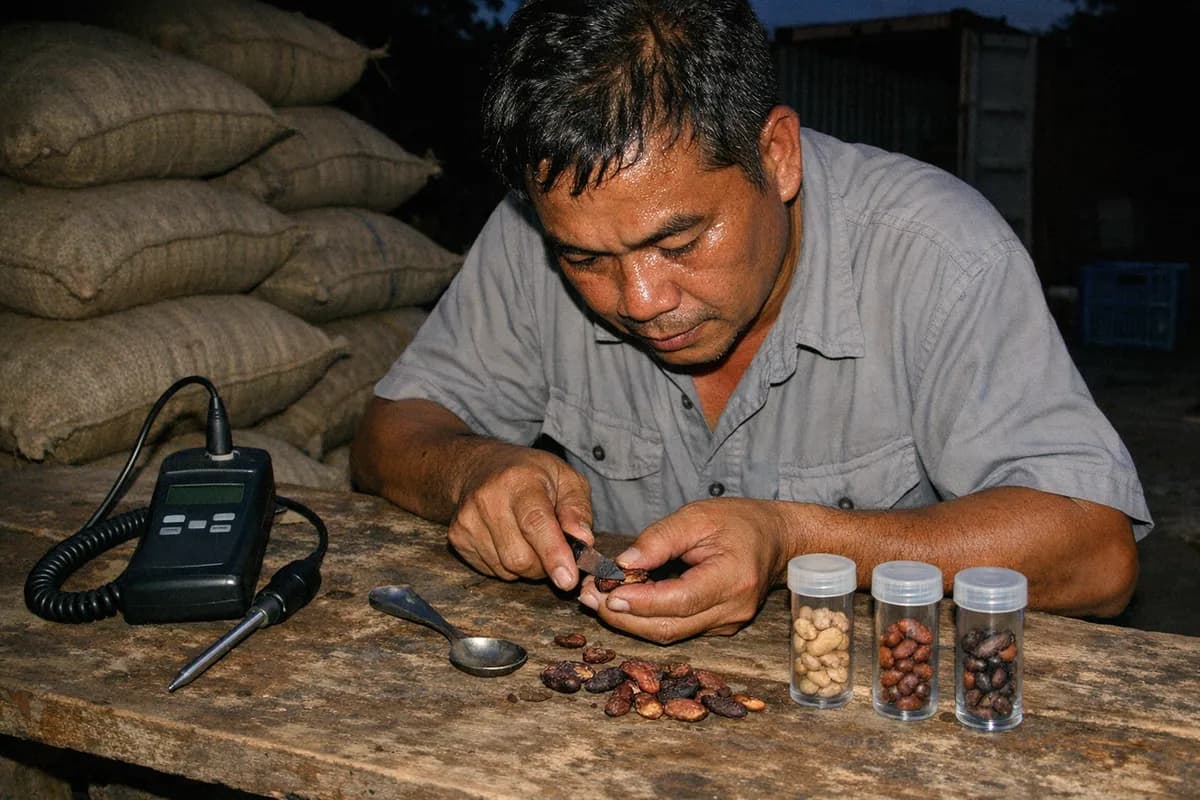
For example, our Sulawesi Fermented Cocoa Beans, Grade A are specified with bean count ≤ 100 / 100 g (SNI size class A), moisture ≤ 7.5%, fermentation level ≥ 85%, fat content ≥ 52%, mouldy beans ≤ 3%, slaty beans ≤ 3%, insect-damaged beans ≤ 1%, minimum order 13 MT (1 × 20 ft FCL), 60 kg jute bags, lead time 2–3 weeks, Rainforest Alliance, ISO 22000, Halal (BPJPH), FOB, CIF, CFR, and HS code 1801.00. That detail gives the LC or TT file a clear commercial base.
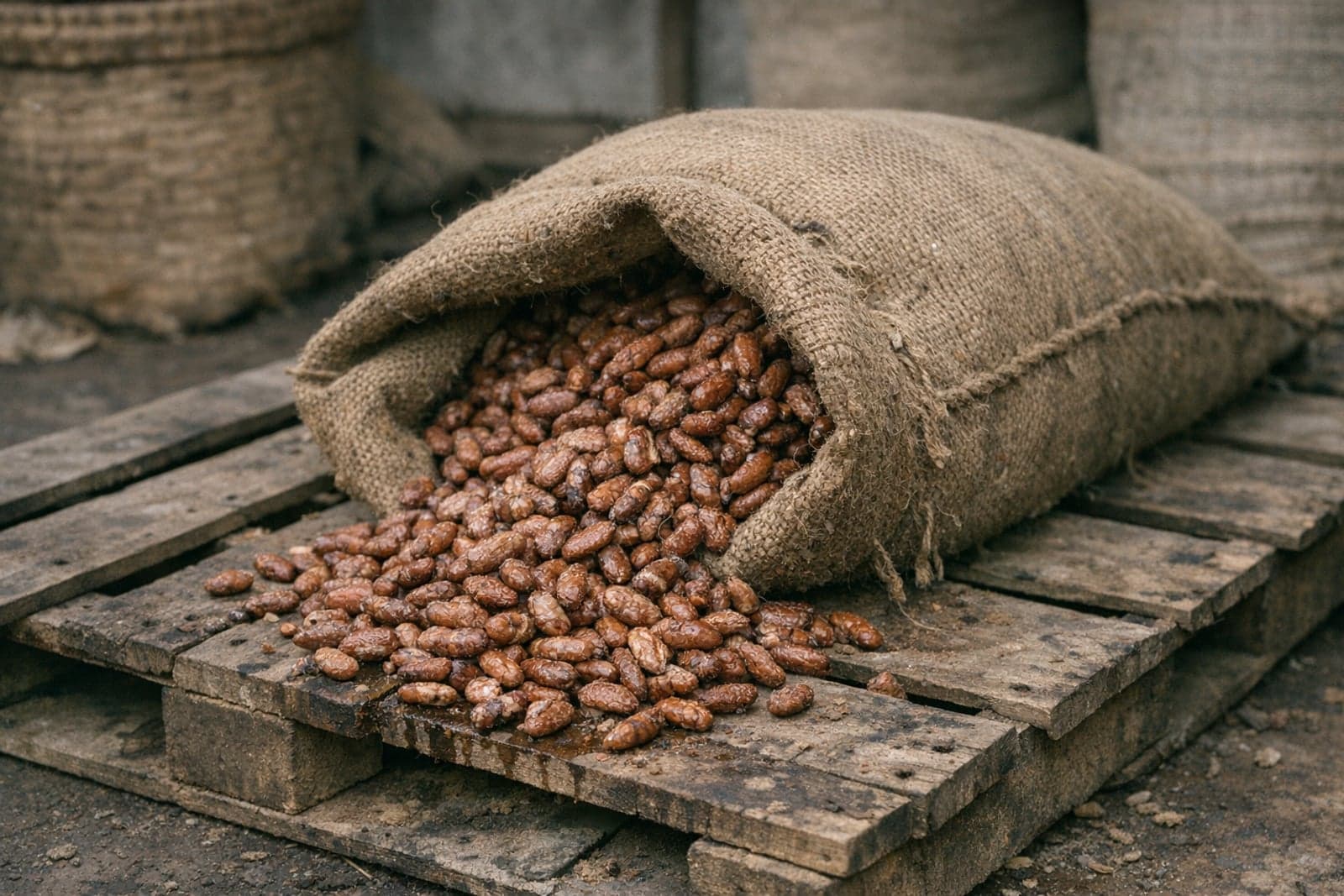
Featured product
Couverture Grade A, Sulawesi Fermented
Bean-to-bar and couverture fermented Sulawesi beans, cut-tested to ≥85% fermentation (house Grade A, SNI size class A).
Rainforest Alliance · ISO 22000 · Halal (BPJPH)
View specificationsThe Incoterm matters because it decides which costs and documents sit with the seller. Under FOB, the buyer usually controls the main freight booking and should arrange cargo insurance through its own process. Under CFR, the seller arranges freight to the named destination port, while the buyer still needs to review insurance coverage separately. Under CIF, the seller arranges freight and insurance to the named destination port, so the buyer should expect insurance evidence in the document set.
If you are still selecting a bean type before discussing finance, start with our Indonesian cocoa beans range and shortlist the origin, process, and grade that match your factory use.
How does a letter of credit work for cocoa bean imports?
A letter of credit is a bank-handled payment method where payment depends on presentation of documents that match the LC terms. Banks examine documents, so the LC must describe the shipment in wording the exporter can meet exactly.
For cocoa beans, LC discrepancies often come from small document mismatches. The product name on the LC may differ from the commercial invoice. The packing list may show bag details that are not reflected in the LC. The bill of lading may use a port name or consignee format that does not match the buyer’s instructions. These are document issues, but they can delay payment and document release.
A workable LC should state the same commercial facts as the approved proforma invoice. The buyer should check:
- Applicant and beneficiary names exactly as registered with the banks
- Product description matching the proforma invoice and purchase order
- Quantity and packing basis, including bag or bulk wording where relevant
- Incoterm and named port
- HS code 1801.00 for whole cocoa beans in our range
- Required documents, with no document requested unless it can be issued
- Shipment window and document presentation timing agreed before opening
- Whether freight and insurance documents are required under the chosen Incoterm
Do not ask for certificates as generic placeholders. If a buyer needs Rainforest Alliance, ISO 22000, Halal (BPJPH), a certificate of analysis, phytosanitary documentation, or a certificate of origin, those should be named clearly and checked against the selected product. Our fermented Grade A beans list Rainforest Alliance, ISO 22000, and Halal (BPJPH). Our unfermented Grade B beans list ISO 22000 and Halal (BPJPH).
An LC is useful when the buyer needs bank control over document release or when internal policy requires documentary payment. The trade-off is that LC wording must be reviewed before issuance. Once an LC is opened with a wrong product description or an unavailable document requirement, the amendment process can slow the shipment file.
How does telegraphic transfer work for cocoa bean imports?
Telegraphic transfer is a bank transfer made under the commercial payment schedule agreed between buyer and seller. The contract should state when payment is due, what triggers each payment, and which documents are released at each stage.
TT is simpler than LC in document handling because banks are not checking every document against LC wording. That does not mean the buyer should accept loose paperwork. The purchase order and proforma invoice still need to show the same product, HS code, Incoterm, packing, quantity, and destination details that will appear on the export documents.
For TT, buyers should define the trigger clearly. A payment trigger could be linked to proforma invoice acceptance, production or lot allocation, shipment booking, scan copies of shipping documents, or release of originals. The exact structure is a commercial agreement between buyer and seller, so it should be written into the proforma invoice before either side treats the order as confirmed.
Document control is the main point to manage. If original bills of lading are used, the buyer needs to know when originals will be released. If telex release or sea waybill handling is used, the buyer should align that with its forwarder and customs broker before shipment. A TT payment schedule that releases funds without a defined document step can create avoidable risk for both sides.
TT can work well for repeat buyers with an approved vendor file, stable document requirements, and a clear receiving process. For a first transaction, many buyers ask for extra document review before payment release. We encourage that review because it catches spelling, port, HS code, bag count, or consignee errors before the vessel arrives.
Send us your target product, destination port, preferred Incoterm, and document requirements through our contact page if you need a quote file that your finance team can review before choosing LC or TT.
What documents should be checked before payment and customs clearance?
A cocoa bean import file should include the commercial, transport, origin, quality, and import-support documents required by the contract and destination broker. The buyer should check consistency across the full set before payment is released or documents are surrendered.
A typical cocoa bean document checklist includes the following:
- Proforma invoice, used to approve product, price basis, Incoterm, quantity, packing, and payment term
- Commercial invoice, used for final shipment value and customs entry
- Packing list, used to check bag count, net weight, gross weight, marks, and container details
- Bill of lading or sea waybill, used for transport and cargo release
- Certificate of origin, where required by the buyer or destination process
- Phytosanitary certificate, where required for plant-origin goods at destination
- Certificate of analysis, used to connect the shipped lot with agreed quality parameters
- Insurance certificate or policy evidence for CIF shipments
- Certification documents when the product and buyer requirement include them
The same core data should appear across documents. Product description should not shift from “fermented cocoa beans” to “raw cocoa” without a reason. HS code 1801.00 should be consistent for whole cocoa beans in our range. Quantity, packing, and weight should reconcile from the invoice to the packing list. The consignee, notify party, vessel details, and port names should be checked before originals are issued.
The certificate of analysis is especially important for cocoa beans because it connects quality approval to a shipment lot. Buyers should compare moisture, bean count, fermentation result where relevant, and defect limits against the agreed product. If your team wants a separate method for reading COA fields, use our guide on how to read an Indonesian cocoa bean certificate of analysis before approving the final file.
Container condition also affects document confidence. A clean packing list does not prove that the container was dry, lined, and suitable for cocoa beans. If your receiving team has moisture sensitivity concerns, review our article on dry container preparation for Indonesian cocoa beans during the booking stage, not after loading.
What are the MOQ and price inputs for Indonesian cocoa beans?
Our fermented Grade A cocoa beans have a 13 MT minimum order, equal to 1 × 20 ft FCL. Our unfermented Grade B cocoa beans have a 5 MT minimum order, with packing available in 60 kg jute bags or bulk depending on the selected product.
We do not state a fixed cocoa bean price in a payment-terms guide because a usable quotation depends on grade, process, packing, Incoterm, volume, certification requirement, freight basis, season, and export-side cost treatment. A price without those inputs is not ready for LC issuance or TT approval.
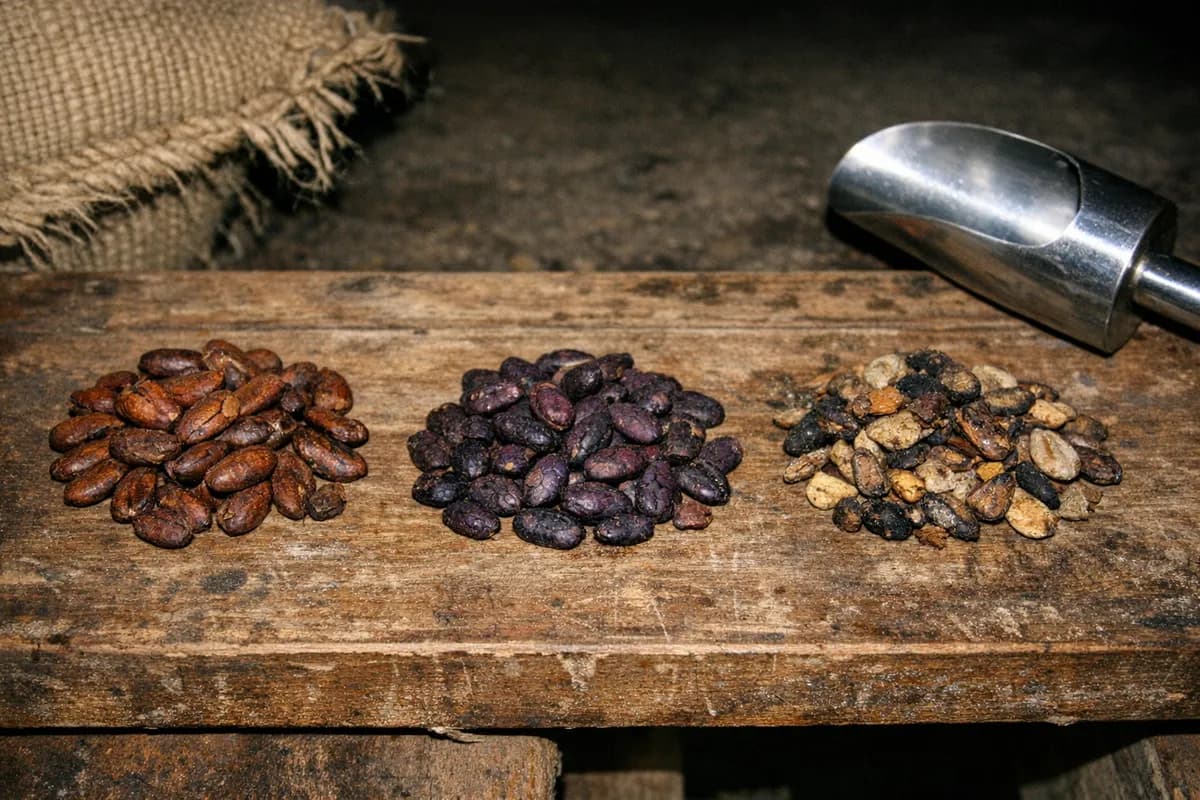
Fermented Grade A beans and unfermented Grade B beans are usually bought for different factory objectives. Fermented beans are normally evaluated with flavour development, fermentation level, defect profile, bean count, and moisture in mind. Unfermented beans are often considered for pressing, grinding, or industrial use where the buying discussion may focus more on processing yield, defect control, moisture, and packing format.
Packing should be agreed before quotation. Fermented Grade A beans in our range are packed in 60 kg jute bags. Unfermented Grade B beans can be supplied in 60 kg jute bags or bulk. Jute bags support tallying, sampling, and warehouse handling. Bulk supply needs the buyer’s receiving system to be ready for that format, so it should not be added after the finance file is already approved.
For landed cost comparison, the buyer should ask the exporter to show the Incoterm clearly. FOB, CFR, and CIF offers are not directly comparable unless freight and insurance responsibilities are separated. Export duty treatment should also be checked as part of the quoted cost structure. Our guide to Indonesian cocoa export duty explains what buyers should ask the exporter to itemise before comparing landed cost.
If you already know the grade, volume, destination port, and payment method your finance team prefers, send those details through our contact page for a current quotation.
How should buyers avoid payment and document discrepancies?
Buyers avoid most payment and document problems by freezing the commercial file before opening an LC or sending TT instructions. The approved file should include one product description, one Incoterm, one document checklist, and one agreed payment trigger.
For LC shipments, ask the exporter to review draft wording before the LC is issued. The review should focus on product description, document names, port wording, shipment period, presentation requirements, and any certificates listed. If a required document is not available for the selected product or destination, fix the LC before it reaches the bank workflow.
For TT shipments, confirm the payment trigger and document release step in writing. The finance team should know whether it is paying against proforma invoice, shipment booking, scanned documents, original documents, or another agreed milestone. The logistics team should know when it can expect the bill of lading or release instruction.
For both methods, keep quality approval and payment approval connected. A cocoa bean order should not move to final document release unless the commercial invoice, packing list, transport document, and COA match the approved buying file. That is the simplest way to keep Indonesian cocoa bean imports clean from quotation to customs clearance.